


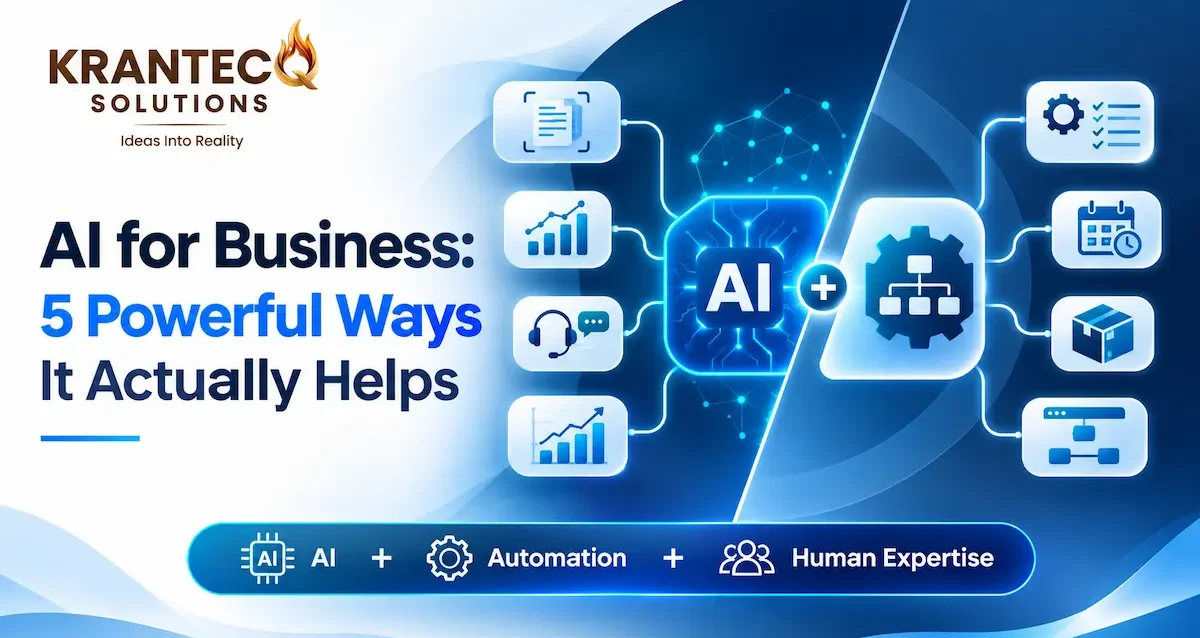
AI for business has become one of the most discussed topics in modern entrepreneurship. From customer support and inventory management to marketing and product development, artificial intelligence is being promoted as the solution to almost every business challenge. But does every business process actually need AI? At Krantecq Solutions, our experience developing enterprise software, AI-powered applications and business automation systems has taught us an important lesson: the most effective technology is not necessarily the most advanced one.
Sometimes, a well-designed traditional software solution can deliver better reliability, lower operational costs and more predictable results than an AI-powered alternative. The real question is no longer whether your business should adopt AI. It is where artificial intelligence can deliver meaningful value.
Where Does AI Actually Help Businesses?
AI for business is most effective in tasks that require interpreting unstructured information, recognising patterns, predicting outcomes, personalising experiences or understanding natural language. Traditional automation is generally better suited to predictable processes such as billing, payment processing, inventory updates and scheduled notifications. For many businesses, the most effective approach is a combination of artificial intelligence, conventional software and human expertise.
Table of Contents
- Why businesses are getting AI adoption wrong
- AI for business vs traditional automation
- Five powerful applications of AI for business
- Where your business doesn’t need AI
- The hidden costs of AI implementation
- How to decide whether your business needs AI
- Why hybrid automation is the future
- Frequently asked questions
- Conclusion
Why Businesses Are Getting AI Adoption Wrong
Artificial intelligence has become a competitive talking point. Businesses want AI-powered websites, intelligent dashboards, automated customer support and AI-enabled mobile applications. However, adopting technology simply because competitors are using it rarely produces sustainable results. Imagine a manufacturing business struggling with inaccurate inventory records. Introducing an AI chatbot will not solve the underlying problem if employees are still maintaining inconsistent stock records across multiple spreadsheets. Similarly, a commercial kitchen experiencing production delays may benefit more from structured employee task assignment and recipe scheduling than from a generative AI assistant.
These are problems that require better processes and reliable digital infrastructure. Before investing in AI for business, organisations should identify the operational problem, understand its root cause and evaluate whether artificial intelligence offers a meaningful advantage over simpler alternatives. AI should support business strategy, not replace it.
AI for Business vs Traditional Automation
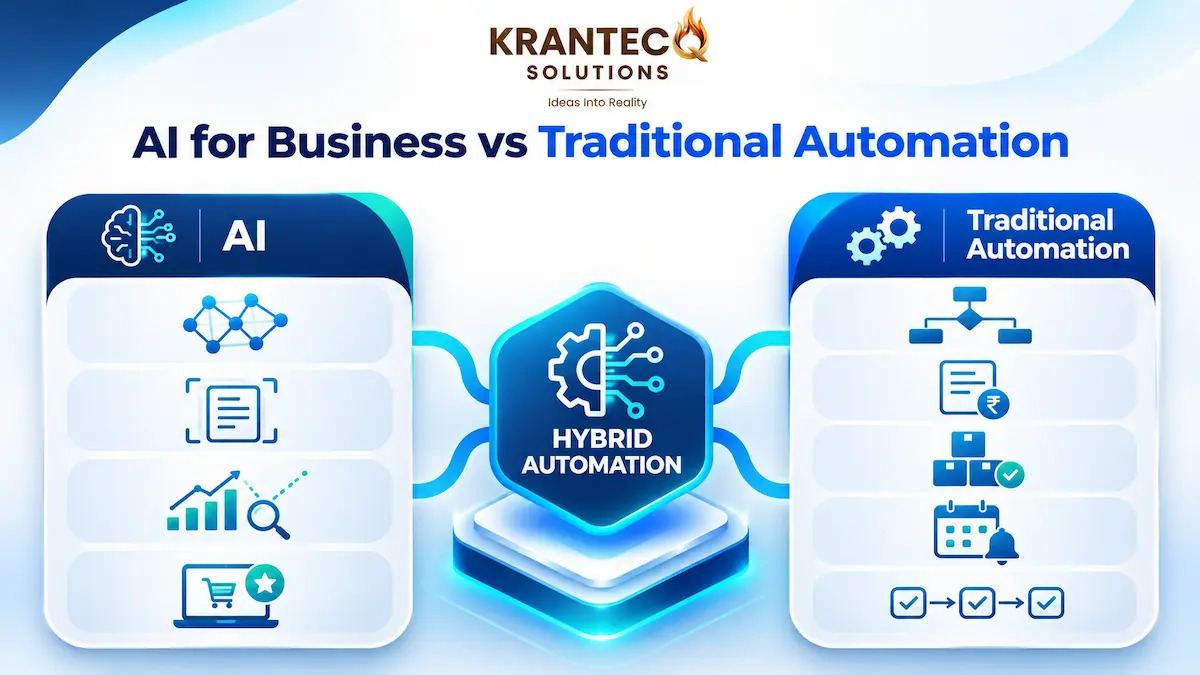
Artificial intelligence and traditional automation are often discussed together, but they serve different purposes. Traditional automation follows predefined instructions. When a specific condition is met, the software performs a predetermined action. Artificial intelligence can recognise patterns, interpret information and generate predictions or responses based on available data. Its outputs may vary and require validation.
| Business requirement | Recommended approach |
|---|---|
| Calculating GST on an invoice | Traditional automation |
| Extracting information from handwritten documents | AI with validation |
| Sending scheduled payment reminders | Traditional automation |
| Forecasting future product demand | AI or statistical forecasting |
| Updating inventory after a confirmed sale | Traditional automation |
| Generating personalised recommendations | AI |
| Processing a customer refund | Rule-based software with appropriate approvals |
| Understanding an unstructured customer complaint | AI with human escalation |
Consider a customer placing an order through a mobile application. Calculating the order total, deducting wallet balances, updating inventory and generating an invoice are structured operations. These processes should rely on predictable business rules. However, recommending products based on customer preferences or interpreting a photograph of a product may benefit from artificial intelligence. Understanding this distinction is essential when planning AI for business.
5 Powerful Applications of AI for Business
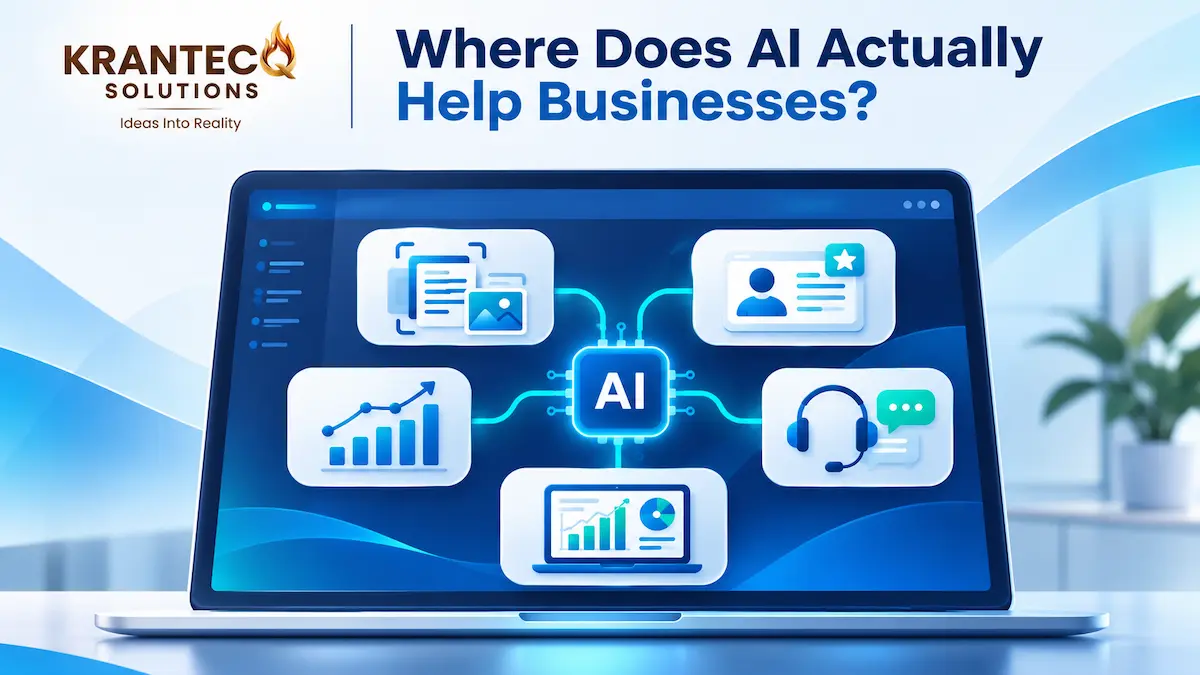
Although artificial intelligence is not necessary everywhere, there are several areas where it can provide substantial advantages.
1. Intelligent Document and Image Processing
Businesses regularly handle invoices, purchase orders, handwritten notes, product photographs, emails and other unstructured information. Manually extracting information from these documents can consume significant employee time.
AI-powered document processing can help businesses:
- Extract information from supplier invoices.
- Identify products from photographs.
- Categorise incoming documents.
- Convert unstructured text into structured records.
- Identify missing or potentially inconsistent information.
For example, a food service business could use AI to extract ingredient quantities from a photographed supplier invoice. The extracted information could then be reviewed and transferred into an inventory management system. However, the AI should not independently approve payments or make irreversible inventory adjustments. Conventional software should validate the extracted data before executing those operations. This combination makes AI for business both practical and manageable.
2. Personalised Customer Experiences
Personalisation is one of the more promising applications of artificial intelligence. Businesses can use AI to recommend relevant products, adapt educational content, provide contextual assistance or generate personalised experiences based on customer preferences. Our experience working on an AI-powered fitness coaching application highlighted an important distinction. Connecting an application to a large language model does not automatically create a genuinely personalised experience. An AI fitness assistant needs relevant information about the user’s goals, preferences, activity history and previous interactions. Without sufficient context, its responses can become generic and repetitive.
Building effective personalisation requires more than integrating an AI API. It requires thoughtful data architecture, context management, prompt design and continuous evaluation. Businesses considering AI-powered customer experiences should prioritise relevance and usefulness over novelty.
3. Demand Forecasting and Predictive Analytics
Businesses often make purchasing, staffing and production decisions using historical experience and spreadsheets. Predictive analytics can help identify patterns that are difficult to recognise manually.
Potential applications include:
- Forecasting product demand.
- Estimating ingredient requirements.
- Identifying seasonal sales patterns.
- Anticipating staffing requirements.
- Detecting unusual operational trends.
Consider a commercial kitchen preparing thousands of meals across multiple locations. A forecasting system could analyse historical consumption, upcoming orders and seasonal variations to estimate ingredient requirements. However, accurate forecasting depends on reliable historical data. If inventory records and production figures are inconsistent, even an advanced AI model may produce unreliable predictions. Our experience developing commercial kitchen management software reinforces the importance of establishing structured operational data before introducing predictive intelligence.
Businesses should also compare machine learning models against simpler statistical forecasting methods before committing to a more complex solution.
4. Intelligent Customer Support
Customer support is another area where AI for business can provide practical value. AI can help support teams interpret customer queries, summarise lengthy conversations, categorise incoming requests and retrieve relevant information from company documentation.
A well-designed AI support system can assist with:
- Frequently asked questions.
- Ticket classification.
- Conversation summarisation.
- Suggested responses.
- Knowledge base searches.
- Identifying requests requiring human intervention.
However, not every support activity requires artificial intelligence. While developing our own structured software support platform, KQ Desk, we identified several processes that are better handled through conventional software. Ticket assignment, service-level tracking, status transitions and scheduled closure can follow predefined rules. AI can potentially complement these workflows by interpreting customer messages or summarising complex issues. The objective should be to improve the support team’s effectiveness rather than remove human accountability.
5. Data-Driven Business Decisions
Modern businesses generate information across sales platforms, operational dashboards, customer applications and financial systems. AI can help decision-makers explore this information through natural language, identify unusual patterns and generate preliminary summaries.
Instead of manually reviewing multiple reports, a manager could ask:
- Which product categories experienced declining sales?
- Which operational processes frequently experience delays?
- What patterns are associated with customer cancellations?
- Which locations are experiencing unusual demand?
Artificial intelligence can help surface relevant information, but its conclusions should be checked against the underlying data. For financial, legal, medical and other consequential decisions, appropriate human review remains essential. The value of AI for business lies in improving access to information and supporting better decisions, not blindly replacing professional judgement.
Where Your Business Doesn’t Need AI
Some business processes require accuracy, consistency and predictable behaviour rather than artificial intelligence.
These include:
- Billing and taxation calculations.
- Payment processing.
- Wallet transactions.
- Inventory stock adjustments.
- Employee attendance records.
- Permission and access management.
- Scheduled notifications.
- Compliance-driven approval workflows.
For example, our experience developing offline-first manufacturing software involved managing thousands of products, GST billing and label printing. These operations require dependable calculations and consistent records. Introducing generative AI into the actual tax calculation or stock adjustment process would create unnecessary uncertainty. Similarly, commercial kitchen scheduling can often be managed through structured rules involving employee availability, skill requirements, production priorities and task dependencies. A properly designed conventional system can handle these requirements without recurring AI model expenses.
The simplest reliable solution is often the best engineering decision.
The Hidden Costs of AI for Business
Integrating an AI API may appear inexpensive initially. However, maintaining a reliable AI-powered application involves considerably more than paying for model usage.
Businesses should consider the following costs:
- API and model consumption: Expenses can increase as user activity, document volumes and request complexity grow.
- Data preparation: Information may need to be cleaned, organised and made accessible before AI can use it effectively.
- Integration and infrastructure: AI services must work reliably with existing applications, databases and operational systems.
- Evaluation and maintenance: Model responses need to be tested for accuracy, consistency and relevance.
- Security and privacy: Sensitive business and customer information requires appropriate safeguards.
- Human oversight: Employees may still need to review AI-generated outputs, particularly when mistakes could have significant consequences.
The NIST AI Risk Management Framework provides a useful starting point for understanding how organisations can manage AI-related risks. Businesses should evaluate the total cost of ownership rather than focusing exclusively on the initial development expense.
How to Implement AI for Business Effectively
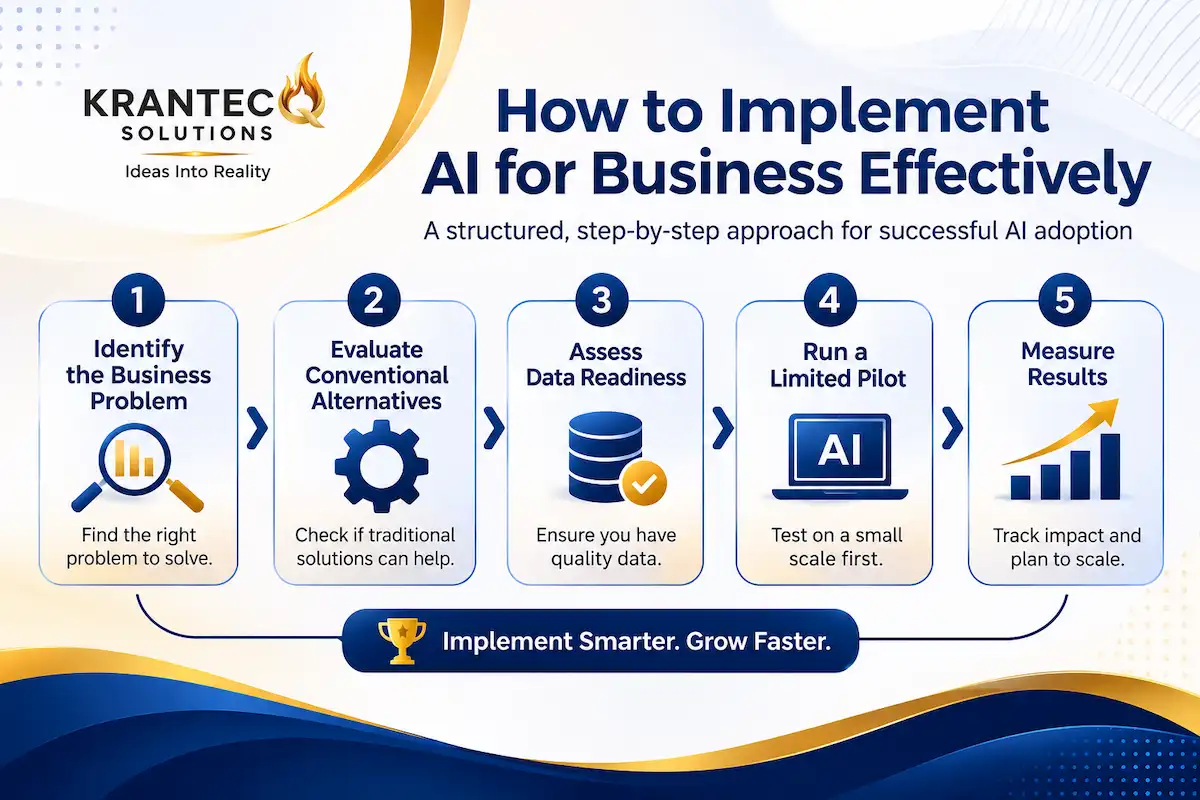
A successful AI implementation begins with a clearly defined business problem. At Krantecq Solutions, we recommend evaluating potential AI investments through a five-step framework.
Step 1: Identify the business problem
Determine which process is inefficient, expensive, inconsistent or difficult to scale.
Step 2: Evaluate conventional alternatives
Ask whether predefined business rules, improved workflows or custom software can solve the problem without AI.
Step 3: Assess data readiness
Determine whether the business has sufficient reliable data or contextual information to support the intended AI application.
Step 4: Run a limited pilot
Test the proposed solution against a clearly defined set of tasks before implementing it across the organisation.
Step 5: Measure results before scaling
Evaluate processing time, accuracy, operational costs, employee productivity and customer experience. The pilot should demonstrate meaningful improvements over the existing process before additional investment is made. The OECD AI Principles also guide trustworthy, transparent and accountable AI implementation.
How to Calculate AI ROI
A simplified return on investment calculation is:
AI ROI (%) = [(Total measurable benefits − Total implementation and operating costs) ÷ Total costs] × 100
For example, suppose an AI-powered document processing solution costs ₹1,00,000 to implement and ₹10,000 per month to operate. If it delivers measurable productivity value of ₹30,000 per month, its estimated monthly net benefit is ₹20,000. Under these illustrative assumptions, the initial investment could be recovered in approximately five months. Actual results will depend on implementation quality, operating expenses and whether productivity improvements translate into measurable business value.
Why Hybrid Automation Is the Future
The most effective digital ecosystems do not rely entirely on artificial intelligence. Instead, they combine AI, traditional software and human expertise to create reliable, efficient and scalable business processes.
Consider an AI-assisted inventory management workflow:
- Information extraction: An AI model extracts product information from a supplier invoice.
- Data validation: Conventional software checks the extracted information against existing product records and purchasing rules.
- Human oversight: An authorised employee reviews discrepancies and approves the information.
- Transaction processing: The inventory system records the approved transaction and maintains an audit trail.
This approach allows each component to perform the task it is best suited to handle. AI interprets information, traditional software ensures consistency, and human oversight maintains accountability. The hybrid approach is particularly relevant across healthcare, manufacturing, ecommerce, commercial kitchens and subscription-based platforms. Businesses can establish reliable digital infrastructure first and introduce AI selectively as their operational needs evolve.
Explore more perspectives on business technology and digital transformation in the Krantecq Solutions blog.
Frequently Asked Questions
Does every business need AI?
No. Businesses should adopt AI only when it offers a meaningful advantage over conventional software, manual processes or traditional automation.
What is the best use of AI for small businesses?
Document processing, customer support, personalised recommendations and demand forecasting are practical starting points. The best application depends on the business’s specific challenges and available data.
What is the difference between AI and traditional automation?
Traditional automation follows predefined rules, while AI can recognise patterns, interpret unstructured information and generate predictions or responses.
When should businesses avoid using AI?
Businesses should avoid unnecessary AI implementation in predictable processes requiring exact calculations, consistent execution and strict auditability when conventional software can handle those requirements effectively.
Is AI expensive to implement?
Implementation costs depend on the complexity of the solution, data requirements, model usage, integration requirements and ongoing maintenance. A limited pilot can help determine whether a larger investment is justified.
Can AI and traditional software work together?
Yes. A hybrid approach uses AI for interpretation, prediction and recommendations while traditional software handles structured transactions, validation and operational workflows.
How can a business measure the success of AI implementation?
Businesses can measure success through improvements in processing time, accuracy, productivity, customer satisfaction and operational costs compared with their previous processes.
Conclusion: Solve the Problem Before Choosing the Technology
AI for business offers significant opportunities, but artificial intelligence is not a universal solution. Businesses that adopt AI without understanding their operational challenges risk increasing complexity and expenses without achieving meaningful improvements. The right approach is to identify the problem, evaluate available technologies and select the solution that delivers the greatest practical value. Sometimes that solution will involve artificial intelligence. Sometimes it will require conventional automation. Often, it will involve both.
At Krantecq Solutions, we help businesses develop custom software, intelligent applications and automated workflows based on their actual operational requirements. Our approach starts with understanding the business problem rather than recommending a particular technology.
Not sure whether your business actually needs AI?
Let us help you identify the right opportunities for automation, artificial intelligence and digital transformation.