


Business automation for SMEs is becoming essential as growing businesses handle more customers, orders, bookings, payments, and follow-ups. While WhatsApp makes communication convenient, it cannot provide the structured workflows required to manage an entire business. For many small and medium businesses, WhatsApp has become the default tool for almost everything. Customers send enquiries on WhatsApp. Orders are confirmed on WhatsApp. Payments are discussed on WhatsApp. Staff updates, delivery status, booking reminders, customer complaints, and even invoices often move through WhatsApp groups and personal chats.
And honestly, WhatsApp is useful. It is simple, fast, familiar, and almost every customer already knows how to use it. For service providers, restaurants, diagnostic labs, local agencies, retailers, and small business operators, WhatsApp has made customer communication easier than ever. The official WhatsApp Business tools include features such as quick replies, labels, and automated messages that help businesses communicate more efficiently.
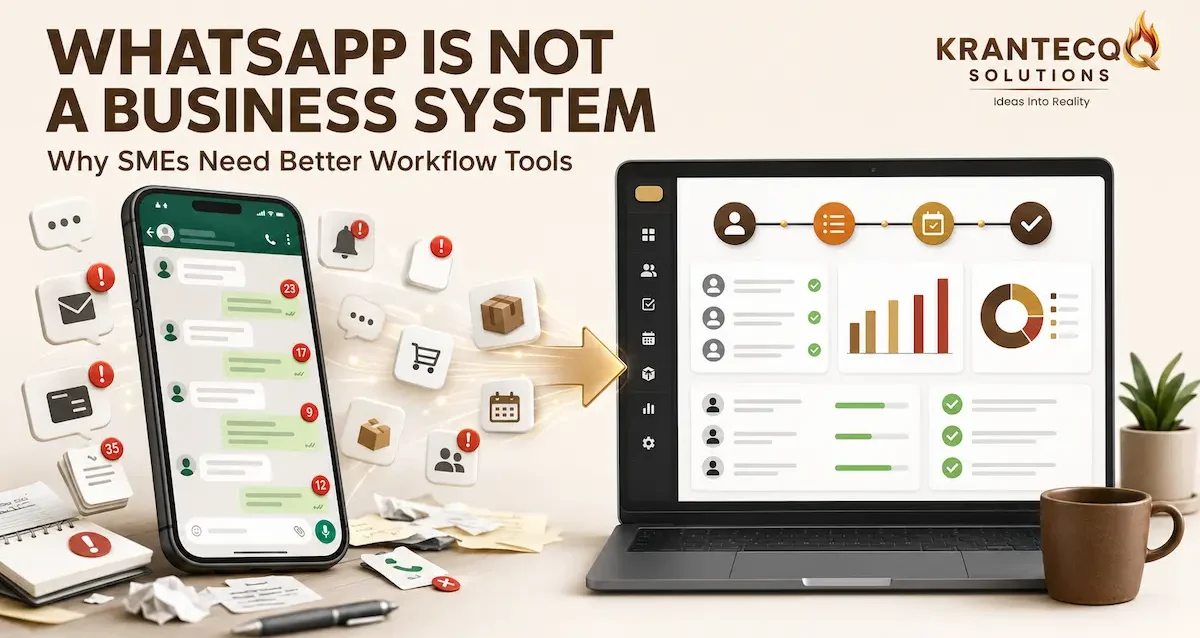
But here is the problem: WhatsApp is a communication tool, not a business system.
It can help you talk to customers, but it cannot properly manage your business operations. It cannot track every order professionally. It cannot remind your team about missed follow-ups. It cannot show you daily revenue, pending bookings, delayed deliveries, team performance, or customer history in one place.
That is where many growing SMEs start facing issues. At the early stage, managing everything through WhatsApp feels easy. But once the number of customers, orders, bookings, staff members, and follow-ups increases, the same WhatsApp-based process starts creating confusion. Messages get missed. Customer details get lost. Team members blame each other. Owners spend hours checking chats instead of focusing on growth. This is why business automation for SMEs is becoming important. Small businesses no longer need only communication. They need proper workflow tools, custom software, CRM systems, ERP solutions, dashboards, and automation that can keep the business organised.
WhatsApp Helps Communication, But It Does Not Manage Workflows
WhatsApp is excellent for quick conversations. A customer can ask for pricing, send a location, confirm a booking, or share a payment screenshot. A business owner can reply instantly and build trust.
But business operations are not only about chatting.
A proper workflow includes enquiry handling, quotation, order confirmation, payment tracking, assignment to team members, service delivery, customer update, feedback, reporting, and repeat follow-up.
WhatsApp does not manage this full journey in a structured way. For example, a restaurant may receive food orders through WhatsApp. Initially, this works fine. But when orders increase, the team needs to know which order is confirmed, which payment is pending, which item is being prepared, which rider is assigned, and which customer is waiting. If all of this is buried inside chats, mistakes become common. The same happens with labs. A customer may book a test through WhatsApp. But the lab needs to manage patient details, sample collection time, phlebotomist assignment, payment status, report upload, and delivery update. WhatsApp alone cannot handle this professionally. For service providers, the problem is similar. Leads come through WhatsApp, but follow-ups, proposals, task assignment, payment reminders, and project updates often get scattered.
This is where a proper business system becomes necessary.
The Problem with Order Tracking on WhatsApp
Order tracking is one of the biggest challenges for SMEs that depend heavily on WhatsApp. This is where business automation for SMEs creates a clear and trackable order process. When every order is handled through messages, there is no clear order status. Some orders are confirmed verbally. Some are discussed but not paid. Some are assigned to staff but not completed. Some are delivered but not marked as closed.
This creates daily confusion.
A business owner may ask:
“Which orders are pending today?”
“Which customers have paid?”
“Which deliveries are delayed?”
“Which staff member is handling this order?”
“Which customer needs a follow-up?”
On WhatsApp, answering these questions means scrolling through multiple chats, checking groups, asking staff members, and manually verifying screenshots or notes. This wastes time and increases dependency on memory. A workflow tool or custom order management system solves this by giving every order a proper status. For example:
New enquiry → Confirmed → Payment pending → Assigned → In progress → Completed → Feedback collected
This simple structure can completely change how a small business operates. With the right business automation for SMEs, owners can see all active orders on a dashboard instead of searching through chats.
Follow-Ups Get Missed Easily

Follow-ups are where many businesses lose revenue. A customer asks for pricing today, but does not confirm immediately. Another customer says, “Remind me tomorrow.” A restaurant customer wants a party order next week. A patient asks a lab about a health package, but needs time to decide. A service provider sends a proposal but forgets to follow up after three days. On WhatsApp, these follow-ups depend on memory, manual reminders, or pinned chats. But when there are 50, 100, or 500 customer conversations, it becomes almost impossible to manage properly. Missed follow-ups mean missed sales.
A CRM system can solve this problem. A CRM system, or Customer Relationship Management system, helps businesses document, track, and manage interactions with existing and potential customers.
For example, a CRM can show:
- New leads received this week
- Customers waiting for a callback
- Follow-ups due today
- Deals that are pending
- Repeat customers
- Lost leads
- Team-wise follow-up status
This helps the business stay active instead of reactive.
For SMEs, a simple custom CRM can be much more valuable than relying on WhatsApp chats alone.
Booking Management Needs Structure
Many SMEs run on bookings and appointments. Diagnostic labs manage test bookings. Clinics manage patient appointments. Salons manage slots. Consultants manage calls. Home service providers manage visits. Restaurants manage table reservations and bulk orders.
WhatsApp can confirm a booking, but it cannot properly manage the booking lifecycle.
A proper booking system should handle:
- Customer details
- Date and time slot
- Service selected
- Staff assignment
- Payment status
- Booking confirmation
- Rescheduling
- Cancellation
- Reminders
- Completion status
When this is managed manually on WhatsApp, double bookings and missed appointments become common.
For example, a lab may assign two sample collections to the same phlebotomist at the same time. A consultant may forget a scheduled call. A restaurant may miss a reservation request during peak hours. A service provider may assign a technician without checking availability. These are not small mistakes. They directly affect customer experience. Business automation for SMEs helps create a proper booking flow where every appointment is visible, trackable, and manageable. Customers get better service, and the team works with more clarity.
Team Coordination Becomes Messy in WhatsApp Groups
Most small businesses create multiple WhatsApp groups for internal coordination. One group for orders. One for delivery. One for accounts. One for support. One for managers. One for field staff. At first, this feels organised. But over time, groups become noisy. Important messages get mixed with casual updates. Staff members miss instructions. Files are hard to find. Owners keep repeating the same information. There is no proper responsibility tracking. A message like “Please handle this customer” does not clearly show who accepted the task, what the deadline is, whether it was completed, or what the result was.
This is why task management and workflow tools are important.
A better system can assign tasks to specific team members, set deadlines, track progress, and show pending work. For example:
- Order assigned to the kitchen team
- Delivery assigned to rider
- Sample collection assigned to a phlebotomist
- Lead assigned to sales executive
- Complaint assigned to the support team
- Invoice assigned to the accounts team
Now the owner does not need to keep asking, “What happened to this?”
The system itself shows the status.
Reporting Is Almost Impossible on WhatsApp
Every business owner needs reports. Even a small business needs to know what is happening daily, weekly, and monthly.
But WhatsApp does not provide business reports.
It cannot tell you:
- Total orders received today
- Total revenue this week
- Pending payments
- Most demanded service
- Repeat customers
- Staff performance
- Customer complaints
- Cancelled bookings
- Average delivery time
- Lead conversion rate
Without reports, business decisions are based on guesswork. A restaurant owner may not know which items sell the most. A lab may not know which health package has the highest demand. A service provider may not know which marketing channel brings the best leads. A small agency may not know which client work is delayed.
Dashboards solve this problem.
A custom business dashboard gives the owner a clear view of operations. Instead of checking 20 chats and asking 5 people, the owner can open one dashboard and understand the business in minutes. For growing SMEs, dashboards are not luxury tools anymore. They are practical decision-making tools.
Customer History Gets Lost in Chats
Customer history is one of the most valuable assets of any business. A repeat customer should not have to explain everything again. A lab should know which tests the patient booked earlier. A restaurant should know a regular customer’s preferences. A service provider should know previous discussions, quotations, complaints, and payments. But in WhatsApp, customer history is difficult to manage. Chats may be on one staff member’s phone. Numbers may not be saved properly. Old conversations may get deleted. Important notes may be buried under hundreds of messages. If an employee leaves, the customer context may leave with them.
This creates a poor customer experience.
A CRM or ERP system stores customer history properly. Every customer can have a profile with contact details, previous orders, bookings, invoices, payment status, complaints, notes, and follow-up records. This helps businesses deliver faster and more personalised service.
For SMEs, this can be a major growth advantage.
WhatsApp Dependency Can Limit Business Growth
WhatsApp is useful, but depending only on WhatsApp can create serious limitations. That is the real value of workflow automation: using software to reduce manual tasks and manage processes more consistently.
The biggest issue is that the business starts depending on individuals instead of systems. If one staff member is absent, others may not know the customer’s status. If the owner is busy, decisions get delayed. If a phone is lost or chats are deleted, important business information may be gone. A growing business needs processes that work even when the owner is not personally checking every message.
That is the real value of business automation for SMEs.
Automation does not mean replacing people. It means reducing repetitive manual work so people can focus on better service, faster delivery, and customer relationships.
For example:
- Automatic booking confirmation
- Payment reminder
- Follow-up reminder
- Staff task assignment
- Daily sales report
- Customer feedback request
- Report upload notification
- Inventory update
- Invoice generation
These small automations can save hours every week.
What Better Workflow Tools Can Do for SMEs
- Every business does not need a complex enterprise system. According to the OECD’s guidance on SME digitalisation, digital tools can help smaller businesses improve productivity, performance, innovation, and competitiveness.
- For a restaurant, this may include order management, kitchen status, delivery tracking, table booking, and customer database.
- For a diagnostic lab, this may include test booking, sample collection assignment, report upload, payment tracking, and patient history.
- For a service provider, this may include lead management, quotation tracking, project status, payment reminders, and customer support.
- For a retailer or distributor, this may include inventory, billing, order tracking, customer records, and sales reports.
- This is where custom software, CRM, ERP, dashboards, and automation solutions become useful.
- Instead of forcing your business to adjust to a generic tool, a custom solution can be built around how your business actually works.
When Should an SME Move Beyond WhatsApp?
You do not need to stop using WhatsApp. In fact, WhatsApp can still remain an important communication channel.
But your main business process should not depend only on WhatsApp.
You should consider a workflow tool if:
- Orders or bookings are getting missed
- Follow-ups are not happening on time
- Staff coordination feels confusing
- Customer data is scattered
- Reports are prepared manually
- You depend too much on one person
- Payment tracking is difficult
- You cannot clearly see the daily business status
- Customers complain about delays
- You are planning to scale
These are signs that your business has outgrown manual chat-based operations.
How Krantecq Solutions Helps SMEs Build Better Systems
At Krantecq Solutions, we help small and medium businesses move from scattered manual processes to organised digital workflows.
Our focus is not to make technology complicated. Our focus is to make business operations easier. Krantecq Solutions develops practical business automation for SMEs based on each company’s actual workflow. We build custom software, CRM systems, ERP solutions, dashboards, mobile apps, web platforms, and automation tools for SMEs, startups, service providers, restaurants, labs, and growing businesses.
Whether you need a simple customer management system, a booking platform, an internal dashboard, a team workflow tool, or a complete business automation solution, Krantecq Solutions can help you build it according to your actual process.
Our solutions can help you:
- Manage orders and bookings in one place
- Track customer follow-ups
- Assign work to team members
- Store customer history
- Generate reports and dashboards
- Automate repetitive tasks
- Improve team coordination
- Reduce missed opportunities
- Make faster business decisions
The goal is simple: help your business become more organised, scalable, and customer-friendly.
Final Thoughts
WhatsApp is a great communication tool, but it is not enough to run a growing business.
For SMEs, relying only on WhatsApp can lead to missed orders, delayed follow-ups, poor team coordination, lost customer history, and unclear reporting. These problems may look small at first, but they slowly affect revenue, customer trust, and business growth.
The solution is not to remove WhatsApp completely. The solution is to use WhatsApp for communication and use proper workflow tools for business management. With the right business automation for SMEs, even a small business can operate with more clarity, speed, and control. If your business is still managing orders, bookings, follow-ups, staff tasks, and reports through WhatsApp chats, this may be the right time to upgrade your workflow. Looking to build a custom Website, Mobile Application, CRM, ERP, dashboard, booking system, or automation solution for your business?
Krantecq Solutions can help you create practical, easy-to-use software that fits your business process and supports your growth.
Book a consultation with Krantecq Solutions today and let’s discuss how we can automate and organize your business workflow.