


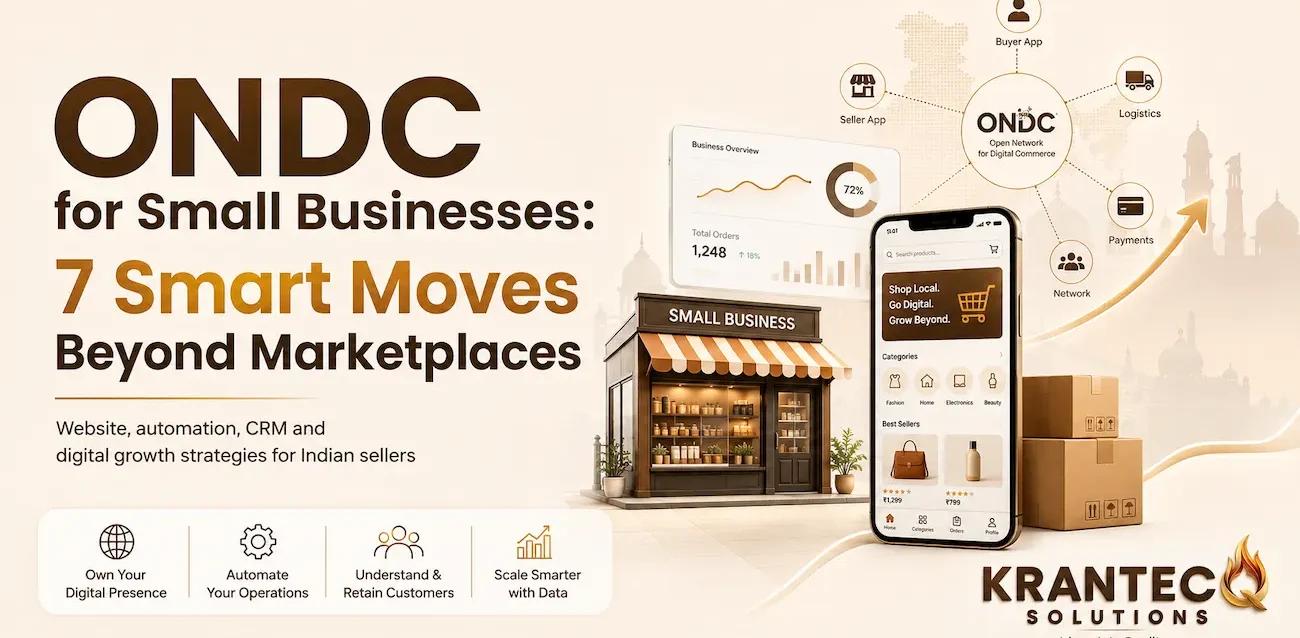
ONDC for small businesses is becoming one of the most important digital commerce opportunities in India. As more MSMEs, local retailers, D2C brands, restaurants, and service providers explore online selling, many business owners are asking one question: should they join the ONDC network, depend on marketplaces, or build their own ecommerce website?
The smart answer is not to choose only one platform. ONDC can help small businesses increase reach, but long-term growth needs your own ecommerce website, customer database, automation system, CRM, inventory dashboard, and brand-focused digital strategy.
For years, small businesses depended on marketplaces, social media pages, offline walk-ins, and WhatsApp orders. But digital commerce is changing. ONDC is creating a more open ecommerce ecosystem where sellers, buyer apps, logistics providers, and technology platforms can connect.
However, visibility alone is not enough. A business also needs brand trust, direct customer relationships, SEO traffic, repeat orders, and backend automation. That is why ONDC for small businesses works best when it is combined with a strong e-commerce website and custom digital systems.
The topic has become even more relevant after Zoho announced a ₹70 crore investment in ONDC to support India’s digital commerce infrastructure and help MSMEs participate more actively in the online economy.
ONDC’s own platform also shows how fast the ecosystem is expanding, with multiple buyer apps, seller network participants, logistics partners, technology service providers, and more than 7.64 lakh sellers/service providers visible through the network.
This brings one important question for Indian small businesses:
If ONDC can help businesses sell online, do you still need your own e-commerce website?
The simple answer is: Yes, in most cases, you need both.
ONDC can help small businesses increase their reach, but your own ecommerce website gives you brand control, customer ownership, SEO visibility, repeat sales, automation, and long-term digital growth.
Let’s understand this in detail.
What is ONDC in Simple Words?
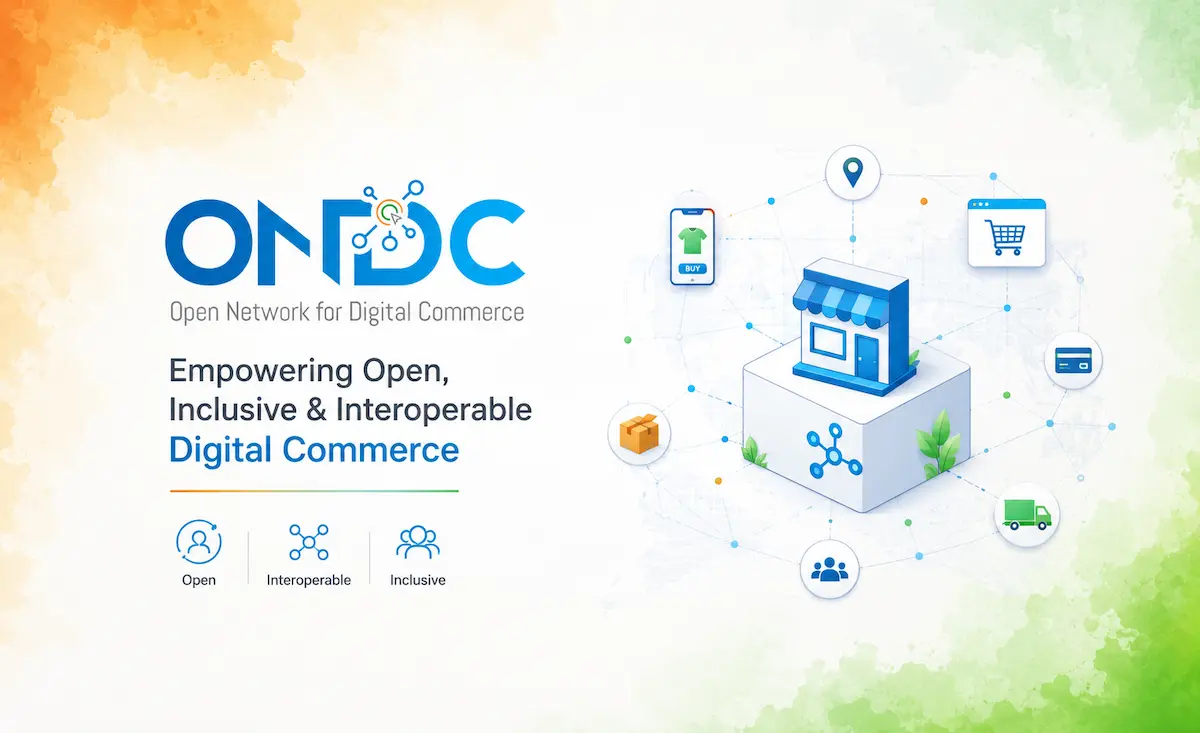
ONDC stands for Open Network for Digital Commerce. It is not a single app like Amazon, Flipkart, Meesho, or Swiggy. Instead, ONDC is an open network that allows different buyer apps, seller apps, logistics providers, and technology platforms to connect.
ONDC describes itself as a communication protocol that allows buyer network participants and seller network participants to interact with each other.
In simple words, ONDC wants to make online commerce more open. Instead of one marketplace controlling the buyer, seller, payment flow, product discovery, and delivery experience, ONDC allows different participants to work together through a shared network.
For example, a customer may use one buyer app to search for a product, while the seller may be listed through another seller platform. The order can still happen through the ONDC network.
This is why ONDC is being discussed as a major opportunity for small businesses, local shops, MSMEs, restaurants, grocery stores, D2C brands, service providers, and regional sellers.
Why ONDC Matters for Small Businesses
For many small businesses in India, going online is not easy. Building a full e-commerce system, managing inventory, running ads, handling delivery, setting up payment gateways, and competing with large brands can feel overwhelming.
ONDC can reduce some of these barriers.
A small seller can get discovered across multiple buyer apps without depending only on one large marketplace. ONDC’s model is designed to connect buyers, sellers, logistics partners, and technology providers in a more open e-commerce setup.
This matters because Indian e-commerce is growing strongly. IBEF reports that Indian e-commerce is expected to grow at a CAGR of 27% and reach US$163 billion by 2026.
For small businesses, this means the question is no longer “Should we sell online?”
The real question is:
“What is the smartest way to sell online without losing control of our brand and customers?”
That is where the ONDC vs own ecommerce website discussion becomes important.
Benefits of ONDC for Small Businesses
ONDC can be useful for businesses that want to start online selling without immediately building a complete digital ecosystem.
The first major benefit is discoverability. A seller listed through ONDC may be visible across different buyer apps connected to the network. This can help small businesses reach customers beyond their offline location.
The second benefit is reduced dependency on closed marketplaces. Traditional ecommerce platforms often control product visibility, commissions, ranking, customer interaction, and policies. ONDC’s open-network approach gives small sellers another route to reach buyers.
The third benefit is access to a wider ecosystem. ONDC includes different roles such as buyer network participants, seller network participants, gateways, and technology service providers. This means sellers may get access to services like catalogue management, logistics, payments, and digital selling support through different participants.
The fourth benefit is MSME inclusion. Zoho’s recent investment also highlights the larger purpose of ONDC: helping MSMEs overcome market access challenges and participate in digital commerce more effectively.
For a small retailer, food business, grocery shop, local brand, or home-based seller, ONDC can become an additional sales channel.
But this does not mean ONDC replaces your own website.
Why ONDC is Not a Complete Replacement for Your Own E-commerce Website
ONDC can help your business get discovered, but it may not fully solve your brand-building problem.
A serious business needs more than product listing. It needs identity, trust, storytelling, repeat customers, direct marketing, customer data, analytics, and automation.
Your own e-commerce website gives you that control.
When a customer visits your website, they see your brand, your story, your products, your reviews, your offers, your contact details, your policies, and your complete shopping experience. You control the design, product pages, landing pages, checkout flow, SEO content, tracking, remarketing, and customer journey.
On ONDC or any marketplace-like ecosystem, your business may be visible, but the customer experience is still influenced by the app or network participant being used.
That is why your own e-commerce website is not just a selling platform. It is a digital asset.
A website helps your business rank on Google, attract organic traffic, collect leads, run ads, connect with WhatsApp automation, integrate CRM, manage inventory, track customer behaviour, and build long-term brand value.
For example, if you run a clothing store, ONDC may help your products appear in front of buyers. But your own ecommerce website can show your full collection, size guide, festive offers, customer reviews, brand story, return policy, blogs, and loyalty discounts.
If you run a food brand, ONDC may bring orders. But your own website can help you build subscriptions, prepaid plans, special menus, corporate orders, and direct customer relationships.
This is the real difference.
ONDC can bring reach. Your website builds ownership.
ONDC vs Own E-commerce Website: What Should Small Businesses Choose?
Both options have their own value. The right decision depends on your business stage, budget, product type, and growth plan.
| Requirement | ONDC | Own E-commerce Website |
|---|---|---|
| Online discovery | Strong through buyer apps | Depends on SEO, ads, and marketing |
| Brand control | Limited | Full control |
| Customer data ownership | Limited | Strong |
| SEO ranking on Google | Limited | Strong |
| Custom design | Limited | Fully customizable |
| Product storytelling | Limited | Strong |
| Repeat customer strategy | Depends on platform/app | Fully controllable |
| Offers and loyalty program | Depends on the seller’s setup | Fully customizable |
| Inventory automation | Depends on the provider | Fully customizable |
| Payment gateway control | Depends on setup | Full flexibility |
| CRM and WhatsApp integration | Limited or provider-dependent | Fully possible |
| Long-term digital asset | Partial | Strong |
The best answer is not always ONDC or the website.
For most growing businesses, the best strategy is:
Use ONDC as an additional sales channel, and use your own e-commerce website as your main digital business platform.
The Smart Strategy: ONDC + Your Own E-commerce Website
Small businesses should not look at ONDC as a replacement for their website. They should look at ONDC as one more channel in their e-commerce strategy.
Think of it like this:
- Your e-commerce website is your digital showroom.
- ONDC is an additional discovery and sales network.
- WhatsApp is your customer communication channel.
- CRM is your lead and customer management system.
- Inventory software is your backend control system.
- The analytics dashboard is your business decision system.
When all these systems work together, your business becomes digitally scalable.
For example, a local electronics seller can use ONDC to reach new customers, but the same seller can use their own ecommerce website to showcase premium products, publish comparison blogs, collect warranty registrations, run Google Ads, manage repeat buyers, and offer service support.
A grocery store can use ONDC for daily orders but use its own website or app for monthly subscriptions, wallet offers, recurring customers, apartment delivery plans, and loyalty points.
A D2C skincare brand can list products on ONDC, but its own website can handle influencer traffic, SEO blogs, product education, reviews, bundles, and customer retention.
This hybrid approach is more powerful than depending on only one platform.
What Technology Does a Small Business Need Before Selling Online?
Before joining any e-commerce channel, small businesses should prepare their digital foundation.
A proper e-commerce setup usually includes a responsive website, product catalogue, payment gateway, inventory management, order management, customer database, delivery workflow, offer management, and analytics dashboard.
If your business receives many customer questions, WhatsApp automation can also help. Automated order updates, abandoned cart reminders, product inquiries, invoice sharing, and support messages can save time and improve customer experience.
If your business has multiple branches, warehouses, vendors, or sales staff, then a custom dashboard becomes even more important. A dashboard can help you track sales, stock, customers, orders, payments, refunds, delivery status, and performance reports from one place.
This is where custom software development becomes useful.
A growing business should not depend only on manual Excel sheets, WhatsApp chats, and scattered order records. As online orders increase, manual systems create confusion, stock mismatch, delayed delivery, payment errors, and poor customer experience.
A custom e-commerce website or business software can solve these problems.
When Should a Small Business Join ONDC First?
ONDC can be a good starting point if your business is still testing online demand.
You can consider ONDC first if you are a local seller with a limited budget, you do not have a strong brand yet, you mainly want product discovery, or you want to explore ecommerce without immediately investing in a large website or mobile app.
It can also be useful for businesses that already sell offline and want to understand whether customers are willing to order online.
For example, a grocery shop, restaurant, local snacks seller, handmade product seller, or small retail store can use ONDC as an entry point into digital commerce.
But even in this case, you should slowly build your own digital presence through a website, Google Business Profile, social media, WhatsApp catalogue, and customer database.
When Should You Build Your Own E-commerce Website First?
You should build your own e-commerce website first if you want to create a serious brand.
If your business sells products with good margins, has repeat customers, runs ads, wants SEO traffic, needs custom product pages, or wants to collect customer data, your own website is extremely important.
A website is also better if your products need explanation. For example, skincare, health products, fashion, electronics, home decor, furniture, jewellery, organic food, B2B products, and customized products need detailed product pages and trust-building content.
Your own website also becomes important if you want features like:
- Online payment
- Coupon system
- Product variants
- Bulk order inquiry
- WhatsApp order button
- Customer login
- Order tracking
- Reviews and ratings
- Loyalty points
- Referral system
- Subscription orders
- Admin dashboard
- Inventory alerts
- Invoice generation
- CRM integration
- Analytics tracking
These features help you build a stronger business, not just an online listing.
Why Your E-commerce Website is Still Important in the ONDC Era
Many small business owners think that if ONDC exists, they may not need a website.
That is a risky assumption.
Your website is your business identity on the internet. It helps customers search your brand, check your credibility, understand your products, contact you directly, and buy from you without depending completely on third-party platforms.
A website also gives your business long-term SEO benefits.
If someone searches “best handmade candles in India,” “custom corporate gifts in Jamshedpur,” “organic spices online,” or “affordable ethnic wear for women,” your website can rank on Google with the right SEO strategy.
ONDC may help in product discovery through connected apps, but Google search visibility still depends heavily on your own website content, product pages, blog pages, schema, reviews, and local SEO signals.
This is why e-commerce websites are still highly relevant.
In fact, as more businesses join ONDC and other digital channels, having a strong website can help your brand stand out.
How Krantecq Solutions Helps Small Businesses Go Digital
Krantecq Solutions helps businesses build digital systems that are practical, scalable, and growth-focused.
For small businesses planning to sell online, Krantecq Solutions can help with:
- Custom e-commerce website development
- Product catalogue and category setup
- Payment gateway integration
- Order management dashboard
- Inventory management system
- Customer CRM
- WhatsApp automation
- Admin dashboard
- Mobile app development
- Custom SaaS development
- SEO-friendly website structure
- Analytics and conversion tracking
- Business workflow automation
The goal is not just to create a website. The goal is to create a complete ecommerce ecosystem that helps your business sell better, manage faster, and grow smarter.
Whether you want to build your own ecommerce store, prepare your business for ONDC opportunities, automate your order flow, or create a custom dashboard, Krantecq Solutions can help you build the right digital foundation.
Final Verdict: ONDC is a Smart Channel, But Your Website is Your Digital Asset
ONDC for small businesses is a powerful opportunity, but it should not be treated as a complete replacement for your own e-commerce website. ONDC can help with reach and discovery, while your website helps with brand control, SEO visibility, customer data, repeat sales, and automation.
The smartest move for Indian sellers is to go beyond marketplaces. Use ONDC as one sales channel, but build your own ecommerce website, CRM, inventory system, WhatsApp automation, and analytics dashboard to create a complete digital growth ecosystem.
Want to move beyond marketplaces and build your own ecommerce growth system?
Krantecq Solutions helps small businesses create professional e-commerce websites, custom dashboards, payment systems, inventory management tools, CRM platforms, Custom App Development, WhatsApp automation, and scalable digital solutions.
Build your e-commerce website with Krantecq Solutions and prepare your business for the next stage of digital commerce.